Site search


Archives


Categories


Saturday Green Links – 5/21

The Association for the Advancement of Sustainability in Higher Education highlights the work of Harvard’s Sustainability Office. Berklee could really take a page from their book.

That’s all for now. As always, if you find anything interesting this week, send it my way.

A showcase for building green

Planet Police Composting

Over at Berklee.net, I’ve posted an interview with the head of Planet Police, the company that collects Berklee’s food waste for compost. Leon Tarentino had a lot of interesting stuff to say, far more than I could use there, so here’s the rest of the interview. Enjoy!

How did you start this company?

It branched off of a major recycling company, Environmental Operation Management Services (EOMS), about three years ago. We decided to put a separate arm of the company together to handle food waste. It was almost experimental at the beginning. The containers are pretty much the same as you would use for gathering bottles and cans on the campus. Where all of that investment was already made, it was now a matter of seeing if it would work. And it has. There’s a long long way to go, don’t get me wrong, but as of right now, it’s working. And as the desire comes up, everybody will be in position to do more of it.
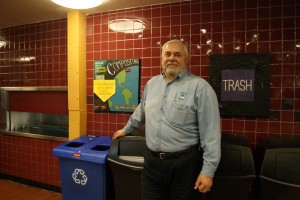
Leon Tarentino of Planet Police

How many customers do you have?

70-75.

What sorts of places?

We’re doing some hospitals. Public schools, we’re just branching into. We do a lot of hotels, restaurants, other colleges. And food manufacturers, bakeries.

What’s your service area?

We cover from the Lynn area north of Boston to Framingham, Natick, and Westborough, and then the Rhode Island line and up the Cape Cod canal and up the south shore, all of Boston.

That’s a huge service area for just four employees!

That’s part of the issue; that’s why we continue to try to grow within it. It’s a route density issue. There’s a lot of driving.

Is it cost effective if gas prices rise?

If the fuel prices keep increasing, it is going to become more of an issue. That’s why we need to get that route density, so they’re stopping more times but less distance. Right now we are doing okay with it.

What is your background?

My background was 32 years in the food service industry, where I worked for a distributor that brought the food to the location rather than away from it. I’ve spent a lot of time in kitchens.

How many other services like this exist right now?

The only other company that does this is Save that Stuff in Charlestown. They have a lot tighter footprint; they don’t branch out to the suburbs much at all. I think Casella has a like service in Vermont, but they don’t do food waste in Massachusetts.

Many times I’ll go in to see a prospect who will say, “I really thought of doing this, I just didn’t know how to go about it,” because there aren’t that many players in the game. At some point in time, when the demand comes up, like everything else, there will be other companies involved, as well.

Are there a lot of different sites that you’re able to take the compost?

There are probably 12 state-approved facilities. But the DEP (Department of Environmental Protection) is trying their best to develop, say, 5 more sites with anaerobic digesters in the state. Right now they’re mostly open-air facilities, either farms or just dedicated compost yards, but it’s an outside process, not internal.

Are these facilities able to compost biodegradable plastic?

Usually in a case where there’s plastic it goes to the digester, because they don’t have an issue with it. But any of the open-air facilities prefer not to have the plastics in there, because it doesn’t decompose at the same rate, and then the finished product doesn’t have the pH levels that, say, all food would have or all yard waste. If we have customers that use the biodegradable or compostable products, then we’ll bring that to a digester facility.

There’s a certain percentage that the farmers don’t have a problem with. They separate it out, anyway. There’s a certain fudge factor, certain things that do get in there that they don’t have a problem handling. At this point, no one has called and said with Berklee we have to treat it differently, so right now it’s going to more outside facilities than the digester.

I heard there weren’t very many anaerobic digesters in the state.

There aren’t. There’s actually one right now, and there’s going to be one in Rockland, and then they’re looking in the southeast area, they want to get down near the border, near the Cape, but they have a tough time. It’s expensive—multimillion-dollar investments. That’s why it’s kind of a dog chasing its tail. Do we have enough material, and do we have the place to bring it? If the DEP had their way they would have mandated last May that you’d have to separate food waste out of solid waste, but they quickly realized if they did that, there wouldn’t be enough haulers or facilities to handle it. So what’s going to happen? It’s going to end up right back in the landfill again. Over time I’m sure they’ll rectify those issues. A lot of out-of-state investors have come forward and they want to spend the money on digesters. It’s honestly a matter of the town or the city not having a problem. The old NIMBY [not in my backyard] thing. I’m on the DEP organic task force to help them to try to establish these facilities.

You wouldn’t think that would be that much of an issue,  because it’s indoors.

It’s an education issue. A lot of people think they’re going to get the downwind effect; they don’t want the smell. These are all internal facilities with scrubbers and the air is cleaned. The one we have in Southborough right now, they have not had a complaint on any odors, because it is well kept internally.

The farmers, unfortunately, they’re closing down year after year. They’re taking the big development money and selling their farms, and of course that’s less facilities. That’s why we need those digesters; we desperately need them.

Less “Pragmatic” than “Lazy”

Another guest post by Sharon Tomasulo, from Library Hungry. Enjoy!

I do consider myself an environmentalist, but I eat too much meat, drive too big a car, and am far too lazy to call myself a good one. I want to be a good steward of the earth, but more in the way I want to go to the gym than the way that I want an ice cream cone—an individually wrapped in non-recyclable packaging, preservative- and chemical-laden Nutty Buddy. Oh yeah.

Adam helps with the recycling.

So in the little moments I snatch in my busy schedule of working, raising a kid, and not going to the gym, what’s the minimum I can do to be part of the solution? What are my tricks for making things a tiny bit easier—just enough to tip them over into “doable”?

  1. Enlist an expert. Seriously, there’s a ton of information out there, and how in the world is a person supposed to decide whether it’s more Earth-friendly to drive five extra miles to buy organic from Whole Foods or go the nearby Johnnie’s Foodmaster, save the gas, and just wash off the pesticides? Luckily, I have a good friend whose blog you are coincidentally reading right now. I am a mediocre researcher, and Brenda often knows the answers to my questions off the top of her head, or knows where to look for the best info. If you don’t have a friend like this, you can borrow mine. I’ve been trying to talk her into adding an “Ask the Pragmatic Environmentalist” feature for a little while now. If you think this is a good idea, send her questions.
  2. Raid your neighbor’s garden. If you have friends and neighbors who garden, chances are they’re offering you tomatoes and zucchini in the summertime. And you know what? They mean it. They’re not just being polite—or rather, they are just being polite, inasmuch as they are not begging and pleading with you to get all this zucchini out of their house, for the love of God.
  3. Get a cherry tomato plant. I say this as an incredibly lazy person who rarely remembered to water hers—that one plant must have given me almost half a bushel of tomatoes last summer, at a rate of 5-15 per day. As someone who hates getting dirty and considers gardening to be significantly less fun than getting blood drawn, I can truly say I love my cherry tomatoes.
  4. Keep a recycling bin in the bathroom. I’m enough of a slacker that by “bin” I mean “paper bag,” but if you care about aesthetics, you could get a more attractive vessel. Do you know how many toilet paper rolls were getting thrown away because I couldn’t bother to bring them downstairs in the middle of the night? How many pill bottles and the boxes they come in, slips of paper that I emptied out of my pockets at the end of the day, cardboard that the new sheets came wrapped in? Most of our recycling lives in the kitchen, but since our only bathroom is upstairs, it never made it in. Now at least 1/3 of our paper recycling comes from upstairs.
  5. Eat the foods you love (that are vegetarian). When I think, “Oh, I should eat more vegetarian meals,” and then try to decide what to make, it goes poorly. I’m too old fashioned—I was raised on meat and potatoes. Veggies were a side dish. But when I find a vegetarian dish that I love, I add it to the rotation, and that can add up. Mushroom and leek gougère, falafel and hummus, cheese lasagna… Non-meat meals are generally cheaper, healthier (even with my, shall we say, liberal use of cheese), and much better for the world.

I have other laziness-related tips, like how you use less harsh chemicals when you just don’t clean your house at all and save water by not showering for a few days in a row. Don’t get me wrong—there are things I do that involve going out of my way—but mostly I’m looking for the path of least resistance in bringing my concerns about the environment into practice in my life, and you’d be surprised how possible that is.

Saturday Green Links – 5/14

I’m sticking with mostly local news this week—there’s a lot going on.

That’s all for now. As always, if you find anything interesting this week, send it my way.

Tales of a Reluctant Rack Dryer

I know that clothes dryers are second only to refrigerators in home energy use, but rack drying clothes has always seemed a little intimidating to me. I don’t know why—my mother used to hang laundry outside (even when it sometimes froze!). But once I was out on my own, like most apartment dwellers, laundromats were the norm. Now our washer and dryer are in the basement, so I sucked it up and got a couple racks. Lines are fine if you have a lot of space, but racks can hold the same amount of clothes with a smaller profile, and they can be folded up and put away when not in use. And you know what? They aren’t so bad.

Where's Oliver?

Here are some tips that made my conversion easier.

  • Don’t rack dry everything. Ease into it with just a few clothes. Jason really wants dryer-soft towels, but has no preferences for jeans and shirts. Since our two racks don’t hold everything all at once, anyway, we can pick and choose.
  • Finish in the dryer. If you still absolutely need the softness (like Jason with the towels), you can dry on the rack until damp and then toss in the dryer for a couple minutes.
  • Dry shirts on hangers. Button-up shirts are actually less wrinkled if they dry this way.

It hasn’t really been as much hassle as I expected it to be. And while clothes do take a day or so to dry, the active part of laundry day is shorter, since you don’t have to wait for the dryer to finish before starting a new load. It’s also supposed to make clothes last longer, too (no lint loss), but I’ll have to get back to you about that.