


Massachusetts Green Communities
Before the passive house tour last week, Cambridge mayor Henrietta Davis and state senator Sal DiDomenico welcomed lawmakers and community advocates to a legislative breakfast, with presentations by Lisa Capone on Green Communities; Rob Garrity on harnessing local volunteers; and Paul Lyons on solar development. There was so much info in this session that I’ll break each presentation into its own post. First: Lisa Capone and Green Communities.
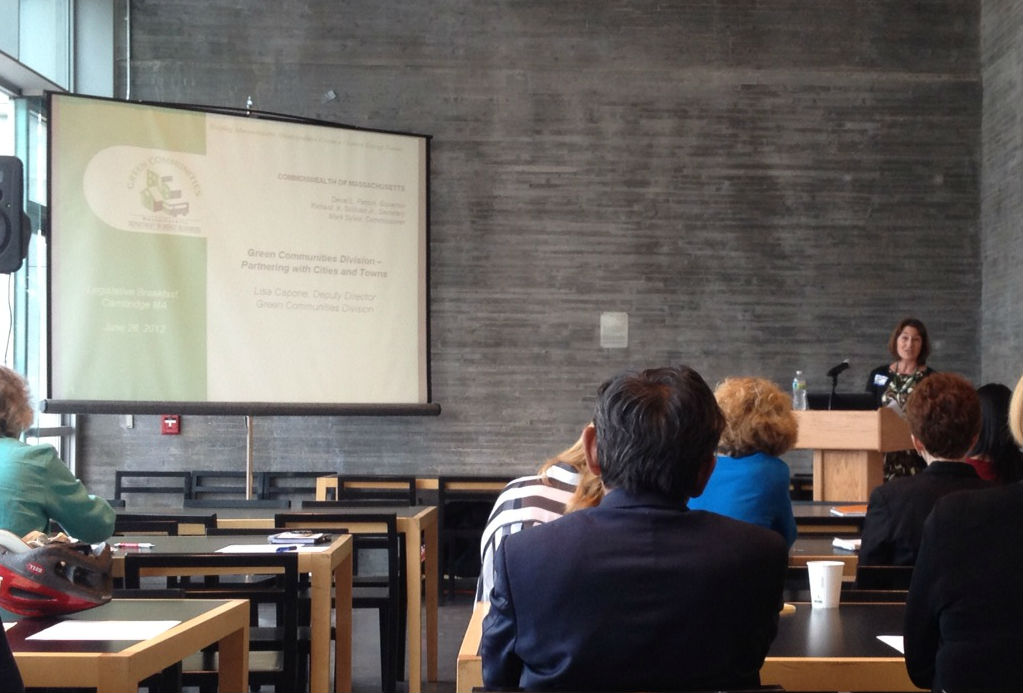
Lisa Capone speaks at the legislative breakfast.
I think I want to be Lisa Capone when I grow up. With a background in environmental communications and public relations, she is now deputy director of the Green Communities Division of the MA Department of Energy Resources. The Green Communities Division oversees, among other things, the Green Communities grant program for cities in Massachusetts. Since 2008, 86 cities (42% of the MA population) have received the Green Communities designation. This means they automatically receive a first-year grant (a minimum of $125,000, with increases based on population) and are able to apply for competitive grants going forward. As you may recall Virginia LeClair telling us regarding Dedham, the requirements include:
- Providing as-of-right siting in designated locations for renewable/alternative energy generation, research & development, or manufacturing facilities.
- Adopting an expedited application and permit process for as-of-right energy facilities.
- Establishing an energy use baseline and developing a plan to reduce energy use by 20% within five years.
- Purchasing only fuel-efficient vehicles.
- Setting requirements to minimize life-cycle energy costs for new construction; one way to meet these requirements is to adopt the new Board of Building Regulations and Standards Stretch Code. (This is 20% more efficient than the standard MA building code, and 121 cities have already adopted it.)
Cambridge used its $283,000 grant to make HVAC and lighting upgrades to four buildings that save the town more than $100,000 annually. As Capone said, “These are not flashy projects, but they have an enormous impact on an annual basis.”
The Green Communities grant isn’t the only thing the division oversees. It also provides the MassEnergyInsight tracking tool for all towns in the state and organizes the Solarize Mass program, which is in its second round. So far, 17 communities have collectively increased their solar installations from 29 to 162.
The Green Communities Division just closed up their fifth round of grant applications in May and expect to break 100 Green Communities this year. Capone said that any town interested in applying should:
- Organize an energy committee
- Contact its regional coordinator (Joanne Bissetta for northeast MA)
- Get training on MassEnergyInsight
- Contact its utility about an audit
- Talk to other Green Communities to find out what they’re doing
Capone emphasized that the best decisions are made on the local level, so her division provides support for cities to improve themselves. The Green Communities requirements provide some general guidelines, but the cities are tasked with figuring out the best way those can be applied in their own area.
I appreciate how useful this supportive, voluntary approach can be, but it seems to me like the most effective initiatives, like the stretch code and the Green Communities Act itself, are made on the state level. I’m glad Davis and DiDomenico were able to bring together both local and state lawmakers to discuss these important issues.



Posted: July 5th, 2012 under Energy Use, Political Action.
Tags: Also - free breakfast!, Das Haus, green communities, Lisa Capone, MassEnergyInsight, passive house, passivhaus, Solarize Mass
Pingback from Pragmatic Environmentalism
Time October 31, 2012 at 9:44 pm
[…] said that Greenovate Boston was made possible by Massachusetts’s Green Communities Act of 2008 and a federal Energy Efficiency and Conservation Block Grant that was funded by the […]