Site search


Archives


Categories


Saturday Green Links – 10/9

My number one link this week is to an article my officemate, Lesley, wrote about local beer at Vee Vee in Jamaica Plain. Jason’s going to love this…

In other news, my posts Touring the Casella Recycling Plant and Person-to-Person Car Sharing with RelayRides were reposted at the Cambridge Energy Alliance blog.

And, as always, if you read anything interesting this week, send it my way.

We Use More Energy than Average?

There was a statewide green homes open house last Saturday that I missed (for the Boston Local Food Festival), but in looking through the homes on the website I was amazed to see that one listed their yearly electricity usage as 7,200 kwh for a two-family house. 3,600 per household seemed high to me, so I added up our usage. (A year’s worth is found on the NStar site). The result? 1,693 kwh.

Intrigued, I went online to look up average household electricity use. It’s an astonishing 11,000 kwh a year. Compared to this, the 3,500 kwh green home is efficient, but they both seem inflated. I don’t know why this is. We don’t have air conditioning, which is the single largest energy hog, but our refrigerator (the second largest) is kind of old and not particularly efficient. We do use fluorescent light bulbs, don’t use the heat dry setting on our dishwasher, and plug our electronics into a smart power strip, but I’m not sure those things would add up to that large of a difference.

On the gas side, we use much more than the green home: 114 MMBTUs per year to their 87 MMBTUs—for both households. The average? 86 MMBTUs per household (in the Northeast).

Why the discrepancy? Well, we do have a gas stove, hot water heater, clothes dryer, and furnace.  We specifically got a gas dryer because it’s more efficient than an electric one, but line drying would be more efficient than that. Also, we’ve weatherized our drafty old apartment quite a bit, but I think there’s still more we could do. More involved things, like installing more insulation, a more efficient furnace, or a solar hot water heater (like the green home has) we can’t do because we’re renting.

It’s a little dispiriting to see that we actually use more gas than the average household, and it outweighs our using less electricity. As renters, I’m not sure what else we can do other than turn the thermostat down some more. (And I hate being cold.) I think we’ll start rack drying some of our clothes and see if that makes a difference before doing anything drastic.

One year ago: Don’t Throw It Out.

Boston Local Food Festival: Zero Waste?

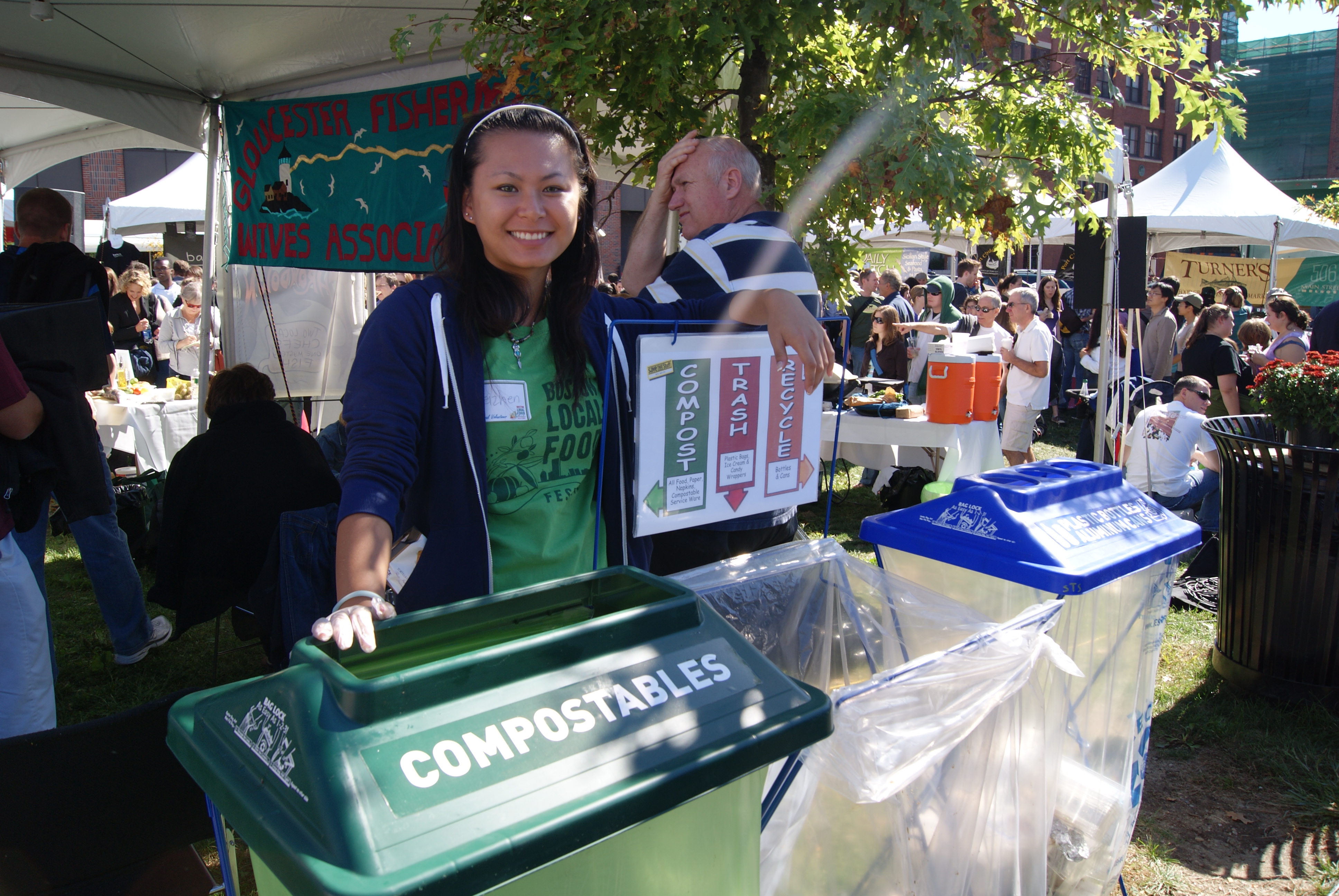
The Boston Local Food Festival was seriously crowded on Saturday. (After elbowing through people for half an hour, Jason and I actually ended up eating lunch at a bar down the street and came back after it cleared out a bit.) There were so many interesting booths, from organic restaurants to local farms to random environmental services that I want to try. But by far the thing I was most impressed with was the trash.

A trash can turned into a lovely fall display

The organizers were trying to make it a zero-waste event, so the regular trash cans around the area were covered up and instead waste stations were sprinkled around the grounds with bags for trash, compost, and recyclables. Even better, a volunteer stood behind each one to help people figure out what belonged where, making sure everything ended up in the right place and turning it into an educational experience.

A lovely trash monitor

I’m not sure how much Save That Stuff was involved with organizing the trash collection, but they were partners for the event and they had a booth there explaining very clearly the recycling process and what different materials get recycled into. They seem to be very proactive when it comes to encouraging people to recycle.

To cut down on the trash, the festival organizers required vendors to serve food and drink in compostable containers, and the water available was tap water (billed as “local water from the Quabbin Reservoir”) served in paper cups. There were still offenders (I’m looking at you, Olivia’s Organics, with salads packed in two layers of plastic), but overall it was far less waste than one would expect from a festival of this size.

I think the Boston Local Food Festival was a model for how waste collection (and reduction) at large events like this should be handled. Now that this has been done well, I’m hoping that other events will follow its example. And I’m hoping that we can do something like this for Berklee events like the Opening Day barbeque, too.

One year ago: Mac ‘n’ Squash.

Saturday Green Links – 10/2

I decided to organize these from personal to international this week. Which do you like better?

That’s it this week. As always, if you read anything interesting, send it along.

Touring the Casella Recycling Plant

On Wednesday I went on a tour of the Casella recycling plant. Cambridge’s recycling director, Randi Mail, is hosting tours before the town switches over to single-stream recycling October 25. Casella is already handling single-stream loads from many towns in Massachusetts, including Boston. It was fascinating to see the elaborate sorting process.

First, giant piles of recyclables are dumped off the trucks and bulldozed onto a conveyer belt, which levels them out into more manageable amounts.

The front of the warehouse, where trucks unload.

A teeny tiny bulldozer pushes the recyclables onto a conveyer belt.

Then the mass of recyclables are spun around a tunnel with 1-inch holes in the sides. Centrifugal force holds lighter materials to the side while glass falls to the bottom and shatters, over and over again, until it can fall through the holes.

Heavier metals (like pots and pans) and rigid plastic (like laundry baskets) are pulled out by hand and dropped into chutes. More than 20 people are stationed at various spots on the line to hand sort, but 99% of their job is to pull out plastic bags before they can gum up the works.

Workers pull out things that can't go through the line.

A magnetic conveyer belt runs over the line to pull out metal. Since aluminum isn’t magnetic, a later spot in the line reverses the polarity of the aluminum to repel it over a barrier and onto another belt.

An idea of the scale

Paper and cardboard slides up rollers spaced at intervals. The paper glides over the top of the rollers, but heavier materials like plastics fall through.

It's amazing how well sorted everything is by the end of the line.

Eight sets of optical sensors ID different kinds of plastics and trigger jets of air to shoot them over a barrier onto another belt.

One of the optical sensors

The end results are baled for transport. The system works remarkably well: the plant director told us that their buyers only allow 2% contamination of each material with another, so it has to be well sorted. Anything that didn’t get separated is run through the system again to capture as much as possible.

Bales of recycling are stacked way over your head.

I expected the warehouse to stink, but it didn’t. I guess that’s a testament to how well people rinse their recyclables. But it was very noisy and very dusty. And hot! I guess an 80-degree day wasn’t the best for a tour.

Some take-aways for me:

  • Plastic bags are death to the machines. The line is only running about 70% of the time, mostly because of plastic bags. So don’t toss them into recycling bins.
  • Plastic smaller than 3 inches falls through and doesn’t get recycled. So bottle caps should always be put back on their bottles.
  • Paper attached to glass gets thrown away, because tiny glass particles stick to it at the plant. So if you want to recycle it, pull it off at home.

If you’re interested in going on a tour yourself, Cambridge is hosting two more this year, on October 28 and November 18. To sign up, email recycle@cambridgema.gov or call 617-349-4815. If you can’t make the tour, you can also watch a video about single-stream recycling on Casella’s website.

One year ago: Revolving Doors.