Site search


Archives


Categories


Saturday Green Links – 6/11

Tuesday green links, more like. But there are lots of them, so I didn’t want to wait another week to post. The top one is particularly interesting to me, since we’re going camping (and mountain climbing!) in a couple weeks.

Phew—that’s a lot! I’ll try to make it shorter next week. As always, if you read anything interesting, send it along.

Random Tip: Donate to Green Streets and Get Zipcar Credit

I just found out that Zipcar will match donations to the Green Streets Initiative with driving credit up to $75 for new members and $50 for current members. Participate in Green Streets’ monthly Walk/Ride Day and get an annual Zipcar membership for only $25, with no introductory fee. It’s a great combo: Green Streets works to promote sustainable transportation, and Zipcar is a useful resource for people who don’t own a car.

Smith Farm CSA

A guest post by Sharon Tomasulo, from Library Hungry.

Brenda’s CSA this year comes from Smith Farm in Hudson, New Hampshire, and I’ve been given the honor of introducing it because I was born there. My parents, Tom and Tina Smith, own and operate the farm, and this is their second year running a CSA in the Boston area.

Pa doubles as Santa Claus in the winter.

In the 1920s, my great-grandparents moved to the edge of Hudson, where they ran a dairy farm. When my grandparents got married, they built a small house next door. My father, Tom Smith, and his brothers and sisters grew up there, where they grew up milking cows every morning and evening (even on Christmas, as he’s fond of pointing out).

When Pa (yes, I call him Pa—I’m told it’s very Laura Ingalls Wilder) was about 12, he started a small roadside vegetable stand, and before long, it was a thriving enterprise. It grew and expanded, and in the late 1960s, the Smiths got out of the dairy business and into vegetables. The sign on the barn still reads H.E. Smith & Sons for Henry Elmer, my grandfather.

By now it’s more than vegetables: the nursery and garden center are a big part of the business. Shrubs, vegetable plants, hanging baskets, annuals, and perennials are a big part of the stock, and the greenhouses open up in February to prepare for the spring. By the time the stand opens up in late April—usually right around Easter—the greenhouses are ready to burst, and you have to put the pansies out in the yard, since pansies can stand a cold night, and there’s just no more room at the inn.

Since it’s New England, the field crops are just starting to come up now. The first CSA shipment will probably be this week, though it will be scant: lettuce, scallions, radishes, beet greens. But by July 4, you won’t be able to get out from under the vegetables: peppers, cucumbers, peas, summer squash, eggplant, onions, carrots, beets, spinach. Corn and tomatoes usually appear a little later, but they’re worth the wait; I have honestly, unbiasedly never tasted corn better than Smith Farm corn.

My brother Dylan works with my father now, in the field and in the farm stand where most of the produce is sold. He’s 27 and is very good at the job. However much they both like to complain, Pa and Dylan work really well together, and Dylan has quickly developed an anxiety about the weather that rivals our father’s.

The farm stand

My mother Tina’s domain is the greenhouse, which is a huge job in the spring and early summer, but trails off toward the end of the summer as the last of the plants are moved out to the stand yard and sold. The only other full-time employee is my aunt, Charli Cohen, who has worked with my parents for as long as I can remember, and who runs the farmstand on weekdays when everyone else is in the field, and works in the greenhouse with Mom the rest of the time. All the rest of the fieldwork is done by part-time high school students who work for the farm in the summer—kids who don’t mind working in the hot summer sun starting at 7:00 a.m. if it means they can be out just after lunch and have their summer afternoons and evenings all to themselves.

The farm isn’t organic; organic certification is a complicated process, and the transition can be risky and expensive. But their use of pesticides and commercial fertilizers remains as low as they can keep it, and they’ve been looking for an affordable source of natural fertilizer—compost or manure—that can come anywhere near the volume they’d need.

Most of the business Smith Farm does is through the farm stand—people on their way home stopping in for fresh ingredients for dinner—but they do have a few local restaurants who buy produce there, like Cobblestones of Lowell. Last year we decided that they should try to run a small CSA, so we did a trial run with just five subscribers, all friends of mine who were willing to deal with the growing pains as we figured out how to make the system work. It went really well, but we decided to keep it small. This year we’ll have seven shares, and next year we may go up to ten. Pa wants to make sure that he can still keep the stand stocked. I can understand that; the whole farm is about 40 acres, run by a very small group of people, and quality is always the first priority.

Of course, I’m not counting my share. Every time I see my parents in the summer, I come away with huge bags and boxes of fruit and vegetables. It can be overwhelming, especially since I’ve only recently figured out how to cook well enough to make good use of most of it. Still, I couldn’t live without it. I spent my entire childhood eating raw vegetables straight out of the picking basket. I remember the shock, going to a farmer’s market in college, of realizing that I couldn’t just grab a green bean and munch, or eat a cucumber as I wandered by. But even living 40 miles away, I manage to recreate that bounty thanks to my parents, Tom and Tina, and my brother Dylan. I’m pretty thrilled that now my friends can, too.

Blue Heron Organic Farm

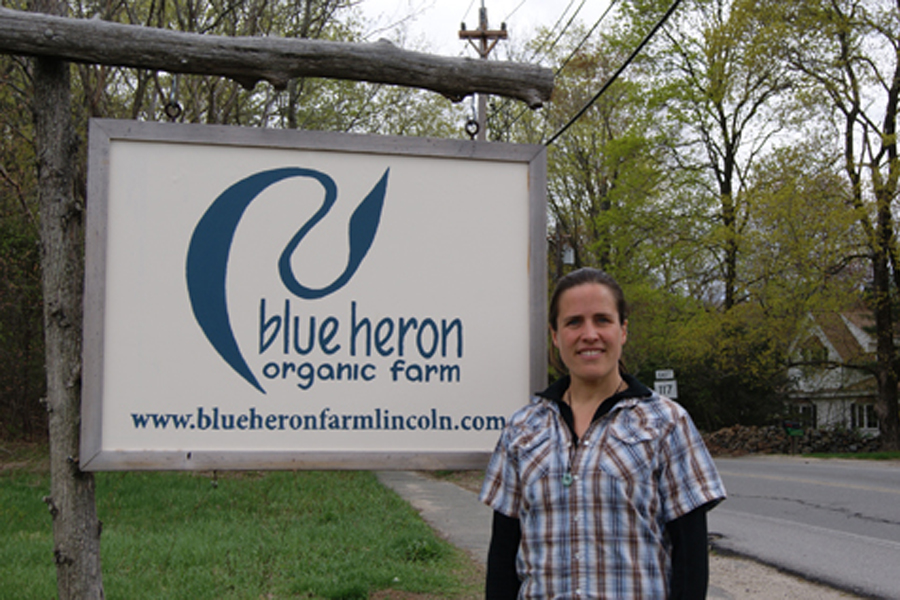
Over on the Boston Local Food Festival blog I’ve got a post up about Blue Heron Organic Farm in Lincoln. Ellery Kimball, the woman who runs it, is possibly the nicest person I’ve ever met, and so full of energy that she makes what I’m sure is back-breaking work look fun.

Ellery with her brand-new sign.

I didn’t have space to get into it over there, but it was interesting to hear exactly what goes into farming organically. These are probably common practices at organic farms, but hers is the first I’ve seen.

  • She plants a cover crop of rye each fall and plows it under in the spring to add nitrogen to the soil.
  • She rotates crops to keep nutrients in the soil and mislead pests accustomed to certain plants. (She actually picks off larger bugs by hand.)
  • She composts manure from a nearby farm to use as fertilizer.
  • She uses an electric fence to keep the deer away. (Although when I was there the fence wasn’t up yet and the deer had gotten to some of the pea shoots. I guess they like them as much as I do.)

…and I’m sure much more, but this was all we got into. If you ever see her or her vegetables around, the farm’s well worth supporting.

Random Tip: Shared Food Program

JJ Gonson, the personality behind Cuisine en Locale and the ONCE dinners, has started up a shared food program. It’s much like a CSA, but with fully prepared meals instead of raw produce. Even better, the meals are delivered to you once a week by bicycle. There’s no vegetarian option yet, so I can’t take advantage of it, but all you omnivores and flexitarians can. And if you do, let me know what you think!