Site search


Archives


Categories


Saturday Green Links – 1/15

Jason will be so happy about the shaving article. He’s been wanting to try an electric shaver for a long time, and this gives him another reason to do so.

I think I’m finally caught up, but I’m always looking for more. If you come across anything interesting, send it along.

Residential Energy Savings with Michael Blasnik: Higher Priorities

On Thursday I went to a lecture by energy consultant Michael Blasnik at MIT. Blasnik’s right up my alley, a very practical environmentalist who bases his recommendations on studies of the real efficiency of energy-saving activities. He’s currently conducting a study of the national weatherization assistance program. So his presentation was full of something I’ve been after for a long time: hard numbers comparing the efficiency of different actions. There were so many I’m going to have to break it up into two posts.

Michael Blasnik

Blasnik emphasized that low-income weatherization programs should focus on the highest energy users. It takes more money to bring their houses up to speed, but it will save more energy per dollar spent. (The best energy savings also occur in locations where it snows most of the year.) A 20–30% improvement is considered a good average.

Some surprising things I learned:

  1. Ten percent of households leave their furnace fan on constantly, which wastes them $600 to $800 a year. Isn’t this crazy?
  2. Second refrigerators and freezers waste a lot of money—$100 to $400 a year. I doubt people save $400 a year by buying in bulk and freezing it.
  3. Shortening showers by 4 minutes per day only saves $20 to $40 a year.
  4. Switching half your laundry to clotheslines only saves $15 to $40 a year. In winter it saves even less energy because the evaporation cools off the house and adds to your heat load.

Higher priorities

  • Switch furnace fan from “on” to “auto” – costs $0 – saves $600–800/yr
  • Insulate empty attic (bypass seal, 1000 ft^2) – costs $1,000 – saves $400/yr
  • Insulate empty walls (dense pack, 1000 ft^2) – costs $1,200 – saves $350/yr
  • Replace old furnace w/less than 92% efficiency (gas, if heat >1200 th) – costs $3,200 – saves $450+/yr
  • Get rid of second fridge – costs $0 – saves $125–400/yr
  • Get rid of standalone freezer – costs $0 – saves $100–250/yr
  • Turn off TV when not in use (vs. on 24 hrs/day) – costs $0 – saves $100–200/yr
  • Turn off stereo when not in use (vs. on 24 hrs/day) – costs $0 – saves $80–160/yr
  • Set back heat 8 degrees, 8 hours per day – costs $0 – saves $75–140/yr
  • Replace 15 bulbs w/CFLs – costs $60 – saves $75–150/yr
  • Lowering thermostat 2 degrees (24 hrs/day) – saves $60-$100/yr
  • Turn computer off (vs. screen saver) – costs $0 – saves $40–120/yr
  • Insulate attic w/existing insulation (bypass seal) – costs $800 – saves $125/yr
  • Motion detectors on outdoor lights – costs $50 – saves $40–150/yr
  • Fix hot water leak – costs $5–150 – saves $50–200/yr
  • Replace old (pre-’93) fridge – costs $500+ – saves $75–200/yr
  • Fans/drapes/etc. instead of AC – costs $0 – saves $20–200/yr
  • Showers reduced by 4 minutes/day – costs $0 – saves $20–40/yr
  • Replace top load clothes washer (1 load/day, hot water) – costs $500+ – saves $65–175/yr
  • Clothesline (½ of loads, 2x savings if electric dryer) – costs $0 – saves $15–40/yr
  • Cold wash laundry (½ of hot loads to warm/cold) – costs $0 – saves $10–40/yr
  • Power strip: computer – costs $0 – saves $10–40/yr
  • Very low flow showerhead (<1.8 gpm) – costs $25 – saves $10–40/yr
  • Air seal using blower door – costs $700 – saves $75–250/yr
  • Power strip: TV – saves $5–50/yr
  • Turn off fans when room is empty – costs $0 – saves $5–20/yr

Harvard’s First LEED Platinum Building

Yesterday I went on a tour of Harvard’s 46 Blackstone Street. The college’s first LEED Platinum building (now one of 39 LEED-certified projects at the college), it houses the college’s Office for Sustainability, Operations Center, and other administrative offices.
Green Building Services Coordinator Ben Myers discusses the building's history.

The site is made up of three buildings that surrounded the old Cambridge Electric Light steam plant. The architect combined the buildings (with glassed-in spaces connecting them) and transformed the space into offices. It was a $10 million renovation of 40,000 square feet, or about $250 per square foot, which is apparently pretty cheap for such a result.
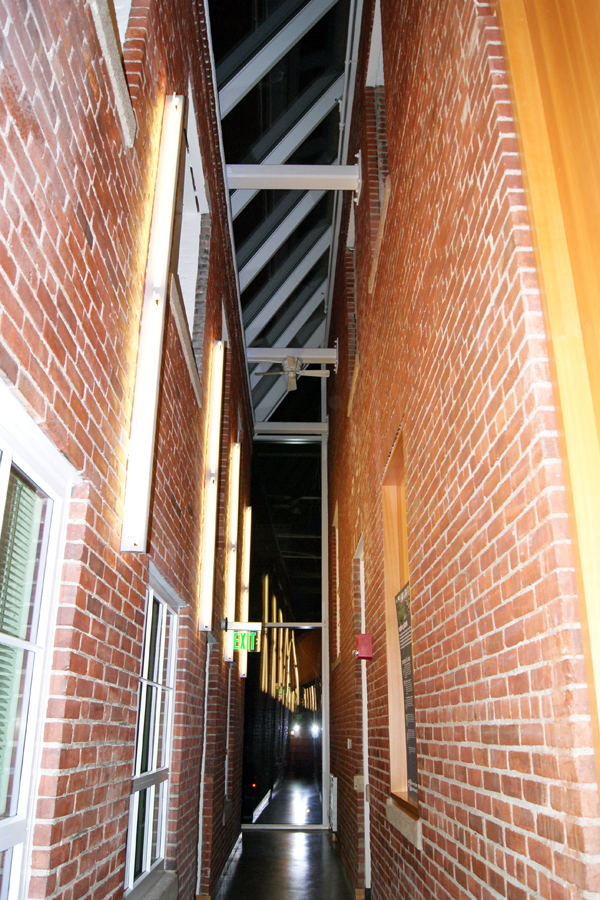
The character of the exterior walls—including windows—is kept intact.

Runoff from the power plant had turned the site into a brownfield, and the college had to rip up the pavement from the parking lot and extract 18 inches of contaminated soil underneath. It was replaced with new fill and permeable paving, with microorganisms in the soil that digest any oil and sand at the bottom of a pond to filter any runoff before it reaches the Charles River. Native plants require no irrigation. Other features:

  • Geothermal cooling with ground source pumps provides cool water that runs through the building. Valance units on the ceiling allow convection cooling without the need for fans.
  • Demand-control ventilation with CO2 monitors saves energy and provides up to 100% outside air, with operable windows for summer use.
  • 5 inches of spray-applied Icynene foam insulation (7 inches at the roof) helps reduce the size of the heating system.
  • Double-paned, argon-infused windows with low-e glazing reduce heat loss.
  • 90% of workspaces receive natural light, thanks to skylights, low cubicles, and glass interior walls.
  • Occupancy/daylight sensors cut down on light usage, and IP addresses for individual fixtures help monitor electricity use, as well as any maintenance issues.
  • Gearless motor elevator uses 60% less energy, with no need for an elevator room. (Unfortunately, Massachusetts code requires one, anyway.)
  • Low-VOC paints, carpets, fabrics, etc. improve indoor air quality.
  • Sub-metering allows monitoring of the energy use of many different parts of the building, with raw data collected by Siemens. The college is looking into using Lucid Design Group’s Building Dashboard to translate that data into more a user-friendly format and installing more green screens college-wide to pass that information on to buildings’ occupants.

The building initially performed much worse than the predicted energy model (30% worse in the first year), mostly because the architects didn’t take into account the need for the Operations Center to be running 24 hours a day, with heat-emitting servers requiring the use of the geothermal cooling pumps even throughout the winter. Once an air conditioner was installed on the roof for that room in particular, the pumps could be turned off from mid-October to April. Also, more equipment than anticipated was plugged in and left on overnight, which required some education and behavioral changes for the occupants. Now the building is performing 16% better than the model, and 43% better than code, in the summer—in both electricity and water use.
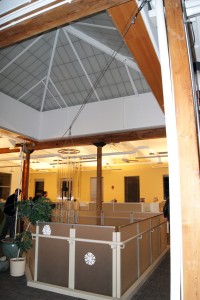
A skylight above the open stairwell infuses light into the building.

The building is part of Harvard’s greenhouse gas emissions reduction plan—with a goal of 30% from 2006 levels by 2016. The initiative is supported by an impressive Office for Sustainaibility, made up of teams including green building services, energy auditing, occupant engagement, and the core group tracking emissions. The office offers a lot of educational information online, including a really comprehensive Green Building Resource.

Most of the people on the tour were architects trying to figure out how to get every credit possible from the LEED system. I may not be an architect, but this is all very interesting to me in light of Berklee’s new building project, a 16-story building at 168 Mass. Ave. I haven’t seen any sustainability plans for it yet, but the architect is the same one who designed the LEED platinum Cambridge Public Library main branch, which seems promising.

One year ago: Fun with a Kill-a-Watt

Saturday Green Links – 1/8

Forgive the number of links today—I’ve had a lot of time to make up for.

I’m still catching up—expect a lot more next week, too. And, as always, if you see anything interesting this week, send it my way.

Adventures in Winter Bike Riding

I’m a bit of a wimp when it comes to riding my bike in the winter. I’ve already promised myself that I won’t do it in a snowstorm (no studded tires), but the cold itself is creating some problems. I’m bundled up enough for it, with a scarf and mittens added to my skullcap and liner gloves. But I hadn’t really thought about the temperature’s effect on my bike. Three times already I’ve had to ride all the way home in first because water somehow made its way into my my gear cable and froze.

Mittens are warmer than gloves.

Bringing the bike inside overnight thaws it out again for the morning, but the ride home’s really frustrating.

Advice is pretty consistent on how to prevent this problem: store the bike in a covered shelter (preferably an unheated one) and wipe it down and grease it after riding in bad conditions.

Unfortunately, I only have outside bike racks at work, I don’t have a garage or shed at home, and I can’t store it in the apartment. It’s not that I would mind it underfoot so much, or the mess it makes on the floor in bad weather, but Oliver tries to escape whenever we open the door (stupid cat). I don’t dare keep it open long enough to wrestle my bike through every night.

Any advice? For now I’m just pretending it’s a fixed-gear and leaving it in second, so if it gets stuck there, I don’t mind. But I’m worried this is having a terrible effect on the bike. I’m definitely seeing rust, and that’s probably why water got into the cable in the first place.

Luckily I don’t have to worry about my brakes freezing, since I have a drum brake on the back. (I love coaster brakes.) There’s no cable to freeze, and it’s enclosed, so ice and snow can’t get in as easily. The front wheel has a rim brake, which could freeze, but I really only use the back brake. At least I won’t have a brake failure while I’m slowly riding home in first…

One year ago: Looking ahead to 2010