Site search


Archives


Categories


Connecting Bike Paths: Charles River to Minuteman

If you saw the Boston Globe piece on bike paths this week, you know that Boston has a lot of them, but most are isolated—often cut off by particularly nerve-wracking stretches of road or dangerous intersections. But Cambridge has been working to improve these connections, even without the space for full-on bike paths.

This weekend, Jason and I biked to Walden Pond: a 20-mile ride with long stretches along one bike path or another. The worst part has always been between the Charles River bike paths and the Minuteman Bikeway, winding through one-way streets and over hills around Harvard Square. But this time we noticed something different: signs!

See? Aren't they great?

A series of new signs directs people along the best route between the two paths, cobbling together quieter streets and bike lanes to make the easiest path possible. And just as you wonder if you might have gotten off the trail—there’s another sign. It’s something I might not have noticed, but my efforts at Tufts and Berklee have made me realize just how much work goes into something as seemingly simple as a sign that materializes just as you need it. First, someone has to discover the need and lobby for the change (probably an otherwise disinterested citizen); then someone has to decide to do it (probably a committee somewhere); finally, someone has to figure out the best way  to do it and actually put up the signs (probably everyday working stiffs). And even then someone will probably complain that they’re not quite right (probably me—have you seen the teeny tiny Bay Circuit signs in Concord?).

So I just wanted to take this opportunity to thank whoever in the City of Cambridge was responsible for those signs. They’re a win.

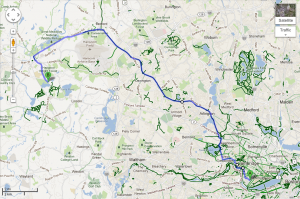
Also, if you’re interested in making the trek yourself, here’s the route we took.
.

Harnessing Local Volunteers with MCAN

Cambridge Day at the dasHAUS exhibit had a lot of material! Check out my previous posts covering it, focusing on passive houses and Massachusetts Green Communities.

Transitioning from Lisa Capone’s talk on Green Communities, Rob Garrity, the executive director of Massachusetts Climate Action Network (MCAN), boasted that the 70 cities covered by his organization’s 46 branches are twice as likely as others to hold the Green Communities designation. MCAN supports local volunteers, organizing them into a statewide movement, and Garrity echoed Capone’s paeon to local government, characterizing it as operational, as opposed to the more ideological state and federal government.

Garrity’s advice was definitely on the operational side of things. He had some great suggestions for the membership of a good energy committee (any committee, really—including Berklee’s reconstituted sustainability committee, perhaps?). These include:

  • native experience (who know about the subject at hand)
  • inspired amateurs (who don’t know their suggestions are crazy and so are more ambitious)
  • old hands (who know how to get things done)
  • cranks (who will complain about the results if they’re not pulled in early)

He also recommends that committees be voluntary rather than appointed, and inclusive rather than limited. This is from hard-earned experience. Garrity’s own town of Norfolk had a limited, appointed committee and was ultimately not able to get Green Communities designation, but a neighboring town with an open, voluntary committee was.

Despite not being able to agree on adopting the stretch code, Norfolk has made a lot of progress, including a new solar facility on otherwise unproductive landfill space. This is why the highly individualistic approach of MCAN is useful. It helps each town customize its climate action plan and get things done, even if they can’t do it all.

Saturday Green Links – 7/7

Despite the unfortunate title, this infographic has a good point. A one-time change that has long-term impact is much more worthwhile than something you have to remember to do regularly.

That’s it this week. If you come across anything interesting this week, send it my way.

Massachusetts Green Communities

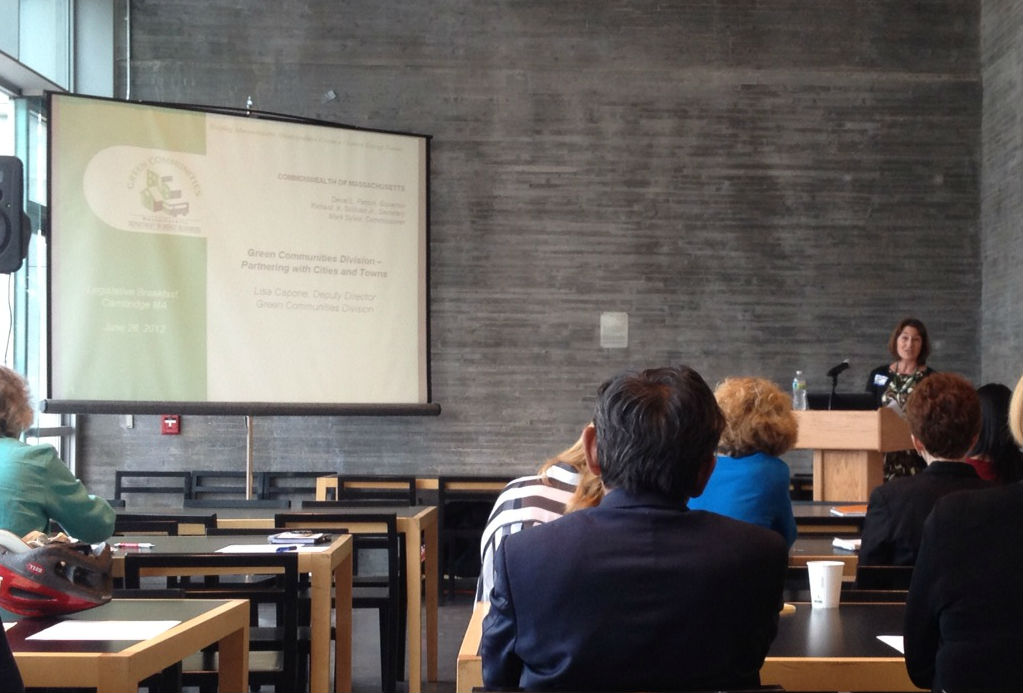
Before the passive house tour last week, Cambridge mayor Henrietta Davis and state senator Sal DiDomenico welcomed lawmakers and community advocates to a legislative breakfast, with presentations by Lisa Capone on Green Communities; Rob Garrity on harnessing local volunteers; and Paul Lyons on solar development. There was so much info in this session that I’ll break each presentation into its own post. First: Lisa Capone and Green Communities.

Lisa Capone speaks at the legislative breakfast.

I think I want to be Lisa Capone when I grow up. With a background in environmental communications and public relations, she is now deputy director of the Green Communities Division of the MA Department of Energy Resources. The Green Communities Division oversees, among other things, the Green Communities grant program for cities in Massachusetts. Since 2008, 86 cities (42% of the MA population) have received the Green Communities designation. This means they automatically receive a first-year grant (a minimum of $125,000, with increases based on population) and are able to apply for competitive grants going forward. As you may recall Virginia LeClair telling us regarding Dedham, the requirements include:

  • Providing as-of-right siting in designated locations for renewable/alternative energy generation, research & development, or manufacturing facilities.
  • Adopting an expedited application and permit process for as-of-right energy facilities.
  • Establishing an energy use baseline and developing a plan to reduce energy use by 20% within five years.
  • Purchasing only fuel-efficient vehicles.
  • Setting requirements to minimize life-cycle energy costs for new construction; one way to meet these requirements is to adopt the new Board of Building Regulations and Standards Stretch Code. (This is 20% more efficient than the standard MA building code, and 121 cities have already adopted it.)

Cambridge used its $283,000 grant to make HVAC and lighting upgrades to four buildings that save the town more than $100,000 annually. As Capone said, “These are not flashy projects, but they have an enormous impact on an annual basis.”

The Green Communities grant isn’t the only thing the division oversees. It also provides the MassEnergyInsight tracking tool for all towns in the state and organizes the Solarize Mass program, which is in its second round. So far, 17 communities have collectively increased their solar installations from 29 to 162.

The Green Communities Division just closed up their fifth round of grant applications in May and expect to break 100 Green Communities this year. Capone said that any town interested in applying should:

Capone emphasized that the best decisions are made on the local level, so her division provides support for cities to improve themselves. The Green Communities requirements provide some general guidelines, but the cities are tasked with figuring out the best way those can be applied in their own area.

I appreciate how useful this supportive, voluntary approach can be, but it seems to me like the most effective initiatives, like the stretch code and the Green Communities Act itself, are made on the state level. I’m glad Davis and DiDomenico were able to bring together both local and state lawmakers to discuss these important issues.

Belated Saturday Green Links – 7/2

The big story in Boston last week: “The seas along the East Coast from North Carolina to New England are rising three to four times faster than the global average.”

That’s all for now. If you find anything interesting this week, send it my way.