Site search


Archives


Categories


Wisdom from Green Metropolis

On Tuesday I wrote about Green Metropolis. But while I gave you my overall impressions about the book, I didn’t go into much detail—and there’s lots of detail! I haven’t thought much about urban planning before, so David Owen’s ideas are kind of revolutionary to me. Maybe they are to you, too?

We’ll Switch to a Dirtier Fuel Source Long Before We Run Out of Oil

“Oil comes out of a hole in the ground, and we set it on fire. It’s a clever but outdated invention of ours…that we will replace with something cleverer as soon as the market determines that doing so is worth our while. The near certainty is that, for many years to come, what the market will replace oil with is not something better (like nuclear fusion, which, at the very least, is decades or generations away) but something worse (such as low-grade coal, China’s main fuel, which makes oil’s carbon footprint and pollution profile look demure).” p. 66

As Fuel Becomes More Expensive, We’ll All Have to Do More Work

“Coal bested firewood as an inexpensive multiplier of economic productivity, and oil and natural gas bested coal. The fossil fuels have enabled us to massively leverage the strength of our bodies, allowing a single farmer to produce the harvest of many, and to produce it on less land, and to ship it farther away, freeing a steadily growing percentage of us to do something other than growing or finding food, and to think of our lives in terms of something other than simple survival.” p. 76

Fuel Efficiency Isn’t the Solution

“Getting more miles to the gallon is of no benefit to the environment if it is accompanied by an offsetting increase in driving—and the standard reaction of American drivers to decreases in the cost of driving, historically, has been to drive more.” p. 96

“The energy inefficiency of individual automobiles…is a far less important environmental issue than the energy inefficiency of the asphalt-latticed way of life that we have built to oblige them….A car’s fuel gauge is far less significant, environmentally speaking, than its odometer.” p. 104

Zoning Is the Problem

“Zoning tends to fully separate residential and commercial uses, to move buildings farther apart and farther from streets and sidewalks, to force low-density developments by limiting building height and lot coverage, and to require the creation of oversized parking facilities, which move buildings still farther apart, usually making them inaccessible to anyone who isn’t driving.” p. 112

Large Parks Can Be Bad for the Environment

“Environmentalists and urban planners sometimes say that, in order to get people out of their cars and onto their feet, developed areas need to incorporate extended “greenways” and other attractive, vegetated pedestrian corridors. It’s true that such features, along with parks and natural areas, can encourage some people to take walks. But if the goal is to get people to embrace walking as a form of practical transportation, oversized greenways can actually counterproductive. Walking-as-transportation requires closely spaced, accessible destinations, not broad expanses of leafy scenery.” p. 181

Traffic Jams Can Be Good for the Environment

“Most so-called environmental initiatives concerning automobiles are actually counterproductive because this effort is to make driving less expensive and more agreeable. What we really need is to make driving costlier and less pleasant.” p. 48

“Building a gorgeous transit system is not enough to make people use it in large numbers; you also have to make the alternatives bleak, by increasing costs, impeding car traffic, and eliminating lanes and parking spaces.” p. 133

Lawns Suck

“The nation’s largest irrigated crop is cultivated grass, which covers more than 32 million acres in the continental United States. (The second largest irrigated crop, at roughly 10 million acres, is corn.) Homeowners spend more than $40 billion a year on their lawns, and they use approximately a hundred million pounds of pesticides, which they apply more heavily than farmers do. A third of all residential water use, furthermore, goes into yards.” p. 191

Solar Panels and Windmills Are Not the Best Ways to Make Your House More Efficient

“The solar peak generally occurs around midday, often several hours before the electric-demand peak, and the extra electrons often have nowhere useful to go.” p. 244

“The days of the year when the extra power generated by turbines would be the most useful to the grid tend to be hot summer days when, almost by definition, power-generating breezes are not blowing.” p. 244

Neither Are High-Tech Windows

“An efficient window has an R-value of 4 or 5. The typical modern house wall, 22.” P. 252

“In a house that doesn’t have air-conditioning, low-e windows can actually increase energy use, by reducing the sun’s effectiveness during the winter at passively heating rooms with southern exposure.” p. 254

Build Smaller and Insulate Well

“The best strategy for making a new single-family house greener is to build it on a small lot in an already dense neighborhood (which increases embodied efficiency), to build it smaller (which consumes fewer resources during construction, requires less energy forever, and discourages the accumulation of unnecessary possessions), to caulk and insulate it more thoroughly, especially under the roof (which helps to keep heat on the correct side of the building envelope in all seasons), and to go easy on the air-conditioning and the inefficient appliances.” p. 236

I really recommend reading the book, but if you don’t get a chance, at least check out the first chapter. It reads like a New Yorker essay, because it is one.

One year ago: A Fly Infestation.

Book Review: Green Metropolis

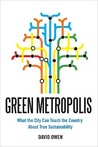
Green Metropolis

There’s just too much here for one post. Check out part two of my review.

Green Metropolis by David Owen gets the biggest compliment I can give a book: I wish I had written it myself. It’s a wonderfully clear explanation of why high-density, mixed-use cities like New York and Boston are more environmentally friendly than suburban or even rural communities.

It seems counterintuitive at first—and you get the sense that the author enjoys being contrarian—but the analysis is compelling. And while I would like more information on how some of the statistics he quotes were gathered, they’re staggering. New Yorkers are collectively responsible for 1% of U.S. greenhouse gas emissions, but they represent 2.7% of the population. This is worth repeating: 2.7% of the population is responsible for just 1% of the greenhouse gas emissions because they live in the city.

How do they manage this?

  • By living in such close proximity to everything they need that they walk, bike, and use public transportation, rather than drive
  • By living in smaller spaces that are easier to heat and cool

Although environmentalism isn’t generally associated with cities, Owen points out that the best way to preserve open spaces is for people to move closer together, not farther apart: “Wild landscapes are less often destroyed by people who despise wild landscapes than by people who love them…by people who move to be near them, and then, when others follow, move again.”

If the residents of New York were to all live at the density of the author’s hometown (around 4,000 residents in 38.7 square miles), “they would require a space equivalent to the land area of the six New England states plus Delaware and New Jersey.” Considering that, us Boston residents are actually doing my Maine relatives a favor by not crowding them out of their towns!

Of course, as Owen points out, the three cities with the highest transit use, New York, San Francisco, and Boston, didn’t get that way because of good urban planning, but because they’re on an island and peninsulas, thus inhibiting outward growth. The real question is how to preserve that unintentional result and duplicate it in places that already have a very different plan.

One year ago: Should I Filter My Water?

Saturday Green Links – 8/21

Jeremy Irons! In a mockumentary about plastic bags! What could be better?

That’s all for now. As usual, if you see anything interesting this week, send it my way.

Interview with Cambridge Recycling Director Randi Mail, Part 2

On Tuesday, I shared my conversation with Randi Mail, recycling director for the City of Cambridge, about Cambridge’s new single-stream recycling program. In the process we touched on some general waste and recycling questions that I thought I’d share here. If you have any other questions or want to attend the recycling facility tour, let me know in the comments and I’ll pass it on to Randi.

Are there any plans for collecting compost in the future?

The limiting factor on that right now is that there is no facility within reasonable driving distance of the city that can handle the kind of volume of food scraps that we’d get if we had a curbside collection program for residents. There are a few private companies that are moving forward with plans to build new facilities for the Boston area, so that needs to come first. We need a facility that can process yard waste and food waste together, similar to the way that the San Francisco and the Seattle programs work. The programs in place for businesses and for the drop-off program, that food waste is being taken to farms that are basically at capacity. They can’t handle the kind of volume that we’d get with the curbside program.

What farms are they being taken to right now?

There’s Rocky Hill Farm in Saugus and Brick-Ends Farm in Hamilton. They’re large-scale facilities, but they’re small when we’re talking about providing collection to everybody in Cambridge. I’ve estimated that we’d see at least 3,000 tons a year; it could be three times that. The food waste drop-off program is basically 50 tons a year—we’d be doing about 50 tons a week.

The farms are doing outdoor composting in windrows, long piles they turn every day. It would be impossible, I think, to site an outdoor composting facility in the Boston area. You’ve got neighbors and odor concerns. So the companies are looking at this technology called anaerobic digestion, where you can do composting indoors in an environment where there’s no oxygen, and they can capture the methane that is emitted during that composting for electricity or fuel. The city of Toronto has a few of these, and it’s very popular in Europe in urban areas.

The city is watching what the private sector is exploring. Casella Recycling, is looking at anaerobic digestion, as well as Save That Stuff, a local hauler. There are a few other projects that are being considered.

I think within the next two to three years we’ll be in a better position to consider curbside organics collection. We’ve had the drop-off program for residents for two years, and businesses have had the curbside organics for four years. We get a lot of questions about this, and I hope we will be in a position to offer it.

The best option, of course, is to try to compost at home. If you have backyard space, DPW sells compost bins for $50. Apartment dwellers can compost indoors with a worm bin.

If you’re not sure whether something is recyclable in your town, is it better to toss it in the bin for them to sort at the center or should you just not include it?

Well, the top items that are not accepted are food, plastic bags, Styrofoam, VCR tapes, liquids, and light bulbs. We don’t take glass dishes or cups, and no plate glass, like picture frames or windows, which can be leaded glass. Currently no pizza boxes, but the new program is going to accept empty pizza boxes. Other than those items, we do accept a lot of materials: all paper, all plastics, glass bottles, metal can, and cardboard. With the new program, any stiff plastic will be accepted, even if it doesn’t have a number on it.

Ultimately, if you’re not sure, I’d say, “When in doubt, throw it out.” But call or visit the website and check. The big no-nos are plastic bags and food waste.

Anything else about the program that you want to share?

I’d love to get the word out about the recycling tours. We’ve got one a month: September 29, October 28, and November 18. They’re open to the public, and it’s a really great way for people to see the recycling process in action and feel confident that what they’re putting in their bin is really getting sorted and sent to companies to be made into new products. Recycling is real, and it’s an important industry in our economy. We have a six-minute video on our website of the recycling processes in Charlestown, so if you can’t make the tour, you can also watch that. To sign up, e-mail recycle@cambridgema.gov or call 617-349-4815.

One year ago: My Biggest Environmental Sin.

Cambridge Switches to Single-Stream Recycling

On October 25, Cambridge is switching to single-stream recycling. Also called zero-sort recycling, this method allows residents to throw all recyclables into one bin, rather than separating paper and cardboard from plastic, glass, and metal. It’s a method that’s already been adopted by many urban areas worldwide, with great results. To find out more about it, I talked to Randi Mail, recycling director for the City of Cambridge.

What are the benefits of single-stream recycling?

Single-stream means that residents can mix clean bottles and cans, paper, and cardboard together in the same bin, so people don’t have to sort recycling anymore. Across the country, communities have seen that when you don’t require sorting, you get a lot more participation. It makes it easier for people. We’re also switching to a different type of truck that can take any size cardboard, so people won’t have to cut their cardboard or flatten it down to three feet by three feet, which is a huge reason why a lot of cardboard in Cambridge doesn’t make it into the recycling truck.

There are also going to be new materials that are going to be accepted as part of the single-stream program: empty pizza boxes; big plastic items like laundry baskets, buckets, plastic toys; spiral cans like those that potato chips, coffee, or nuts come in; and empty paper coffee cups.

The city is going to be providing large recycling toters on wheels to all residences. Providing a bigger container also increases the amount recycled. Sometimes when people’s bins fill up, the rest goes in the trash. So the bigger the bin, the more recycling we’ll get. The toters are easier to move to the curbs; they don’t require lifting. I think the sidewalks are going to be clearer, and the trucks themselves will be safer because they’re going to empty those toters into the back of the truck, rather than over the top. There are a lot of different benefits, from minimizing the trash to cleaning up the streets and just making it easier for people to participate.

How much do you expect recycling to increase?

Cambridge has a pretty high recycling rate already, at about 35%. That includes yard waste, electronics, and food waste that we collect through our composting program. We are expecting between a 10% and 25% increase in recycling tons. We’ve worked with the state to project what the increase will be, and they believe that we’re going to see a 25% increase. We hope to see at least 10%. If we achieve more than that, it will be fantastic.

Have other towns seen increased recycling rates?

Yes. The City of Boston has switched neighborhood by neighborhood—they’ve just finished up—and they are looking at almost doubling their recycling rate across town. Communities in Massachusetts and across the country, like Newton and Worcester, Everett and Chelsea, Quincy and Framingham, every one is seeing a huge increase. You definitely see more when you give out the large toters; some communities have not given those out and they don’t see as big of a jump.

Do you think contamination is going to rise with single-stream recycling?

As always, bottles and cans must be emptied and rinsed out. No food waste is accepted. As long as people are recycling correctly, there shouldn’t be any increase in contamination. It’s not acceptable now, and it’s not going to be acceptable in the single-stream program. If recycling bins have trash, food waste, or other unacceptable items, drivers have the ability to reject them by leaving an orange sitcker. We try to be proactive about educating residents when they’re not recycling properly, to make sure they know what to do right the next week.

Cambridge recycling is pretty clean overall. Our processor is Casella Recycling, they’re based in Charlestown, and they consistently report to us that we have no more than 3% contamination, which is very low, and they’re able to handle that. They’ve told us that we’re probably the cleanest load in the Boston area, and they take from about 50 communities.

Clean recycling is important because the material is marketed to companies that use new products. Good education and immediate feedback to the residents is key. Casella won’t accept loads with more than 7% contamination, that’s part of our contract, and our drivers don’t want to get their trucks rejected, because that causes problems and delays.

The first quality check is the education of residents, because if people know what to recycle, they’re not going to put the wrong stuff in the bins. The second check is when the drivers can reject the bins. And then the third check is at the recycling facility, where there’s sorting going on with different technologies and people. They’re sorting that material and selling it back to markets, so contamination isn’t acceptable. They’ll remove that stuff, whether it’s trash or dirty recycling.

How much is this whole process costing the city?

We’re looking at about $700,000 to purchase toters for 1-5 unit buildings, and the recycling collection contract is increasing a little bit, but really it’s going to present a savings to the city overall, because the more that we recycle, the more the city saves. There’s about a $60 difference between the cost to throw a ton of waste out versus the cost to recycle a ton, so with an increase in recycling we’re going to see disposal savings.

How long will it be until the savings makes up for the outlay?

A few years, definitely, but long term, the city is committed to recycling. And overall, especially with the new vehicles, I think it’s going to make things a lot easier for residents. There are different ways to try to increase recycling, and we’ve decided that single-stream is going to be the one way that we definitely can do. Other communities have implemented pay-as-you-throw systems, where residents pay for each bag of trash that they throw out. That really hasn’t been a program that the city has been able to consider seriously. It’s difficult to implement with so many multi-family units, and I don’t think there’s the political will for that kind of program. By making recycling easier and providing bigger containers, I think we’re going to see the kind of jump in participation that we’re looking for.

What’s happening to the old bins?

People can continue to use the bins inside their houses if they want to fill them up and then empty them in the toters, which would be kept outside. If not, we’re going to be collecting bins at the curb the day after collection through November. There may be broken bins that we recycle, but the other ones we’ll clean, and those will be available to people who are going to continue to use bins.

There are basically three options for recycling come October 25. We’re going to be providing toters to residents. If they feel that they don’t need them or can’t fit them on their property, they have other options. People can convert a trash can for recycling, and we have stickers that people can put on their cans similar to the yard waste program. And the third option, which is really the last resort, is continuing using the small bins.

There are two sizes of toters. Single-family homes are going to get one small, 65-gallon toter. That’s the equivalent of 3 ½ bins. Two-family homes are going to get two small toters, and three- to five-unit buildings are going to get two large toters. Those are 95 gallons, and they can fit the equivalent of over 5 bins. The amount of recycling that we see out of households is definitely going to increase because cardboard’s going to be much easier, and we’re taking those large plastics, so they’re going to take up more space.

If people want to change the size of their toter, they need to contact us by September 1 at recycle@cambridgema.gov or 617-349-4815, when we’re going to be putting the order in. We’ve heard from almost 400 households who want to go bigger, go smaller, or share a bin with a neighbor.

Look for the second half of my interview with Randi Mail on Thursday, when we’ll talk about the possibility of curbside composting, what to do with materials you aren’t sure are recyclable, and upcoming tours of the Casella Recycling plant.

One year ago: Corn Plastic.