Site search


Archives


Categories


Saturday Green Links – 10/8

I’m off to Pittsburgh for the Association for the Advancement of Sustainability in Higher Education conference. Hopefully I’ll have lots of posts for you. Until then, here are some links I came across this week:

That’s all for now. As always, if you see something this week that I might be interested in, send it my way.

Festival Recycling: 3 Lessons Learned

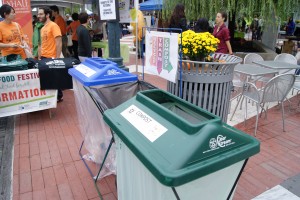
On Thursday I talked about some of the vendors I discovered at the Boston Local Food Festival. But the thing I was really taken with last year was the trash collection. This year they diverted 13.16% more waste  than last year—by composting 3,600 lbs, recycling 1,820 lbs, and only throwing away 900 lbs.

I even tried to model this year’s Berklee BeanTown Jazz Festival on it, which was only somewhat successful. We recycled for the first time—so much that we overflowed our capacity for it. But the composting didn’t go over so well, and the whole thing was unnecessarily hectic.

The Boston Local Food Festival's waste stations.

So what did I learn from the comparison?

  • Require compostable dishes. The Boston Local Food Festival’s composting worked because people didn’t have to dispose of their food and dishes separately or worry that food contaminated their recyclable dishes. Everything could just be thrown in together. Compostable dishes were a requirement that was included in the food vendors’ contracts.
  • Use a single waste disposal company. Save That Stuff handled the collection and disposal of the recycling, composting, and trash. Berklee used Jet-A-Way for trash, Capital Paper Recycling for recycling, Planet Police for compost, and Acme Building Services to collect it all. This made sense in our last-minute scramble to pull this all together, since they’re all companies that Berklee already contracts with, but it made for a disjointed and inefficient system. With one company, the collectors are knowledgable about the process—I saw one Save That Stuff woman reaching into the trash (with gloves) to pull out plates that people had mistakenly thrown away, decreasing the trash by at least half. This is actually in Save That Stuff’s best interest, since it costs more to throw stuff away than to recycle or compost it.
  • Enlist passionate volunteers. The Boston Local Food Festival had two friendly volunteers at each station to educate people about what goes where. BeanTown had one student at each, who had been randomly assigned the job. Some of them were great at engaging festivalgoers; others, not so much. Enlisting volunteers who are actually enthusiastic and knowledgable about reducing waste would help.

The Berklee BeanTown Jazz Festival's waste stations.

There are other things that I might change next year, but these are the biggies. We’re actually looking at hiring Clean Vibes to handle the waste disposal for BeanTown next year. They’re the same company that did the Life Is Good festival. Has anyone else ever used them?

Second Annual Boston Local Food Festival

Despite the threat of rain, this year’s Boston Local Food Festival was even better than last year’s. Extending the festival grounds to the other side of the bridge made more room for the vendors and less of a crush in the crowd. The wide variety amazed me yet again: restaurants, farmers, apiaries, even “green” investing. A lot of them are old favorites, a lot of them are interesting but not my thing, and some I was seeing for the first time. Here are a few:

What a spread!

Ellery Kimball was there with the Blue Heron Organic Farm stand. Jason and I picked up some leeks, butternut squash, and arugala—three things we’re missing in our CSA this year.

Net bags to bring home all the bounty.

I’d never heard of Local Pickins, but it sounds like a great idea. It’s a directory of local farmers markets, bakeries, cheese shops, food trucks, and more. It’s nice to have one place to go for all this stuff.

Neither Pete nor Gerry.

The guys from Pete and Gerry’s were selling custard with applesauce. These are our go-to eggs when we don’t have Stone Soup or Country Hen. I really want to visit their farm in New Hampshire.

Grapes? In Massachusetts?

Bug Hill Farm had the sweetest grapes I’ve ever tasted. Definitely nothing like my old landlord’s.

A cold frame extends the growing season.

Green City Growers installs and maintains gardens in your backyard. It’s perfect for the lazy gardener (me). Do you think they’d do a porch garden for us next year?

A zillion different varieties of flour.

Local flour! I can’t believe Four Star Farms actually grows it in Massachusetts.

This remains my favorite “green” festival (sorry Boston Vegetarian Society!).  The Sustainable Business Network has done a great job with it.

Saturday Green Links – 10/1

The Boston Local Food Festival‘s happening right now next to the Children’s Museum at Fort Point Channel. It’s going on ’til 5:00, so you still have time to make it. Okay, on to the links.

I haven’t had much time for reading this week, so that’s all I’ve got for you. But that just means you can run right out to the Boston Local Food Festival—go, now!

Dedham Environmental Coordinator Virginia LeClair, Part 2

On Tuesday I shared the first part of my conversation with Virginia LeClair, environmental coordinator for the town of Dedham, about the evolution of her job. We also talked about some outreach campaigns that the town is still working on. Read on to find out more.

What’s the Cool Dedham campaign?

The Cool Dedham campaign is modeled after the Cool Mass campaign, which is through the Massachusetts Climate Action Network. The town of Dedham was one of nine communities to be chosen to participate in this groundbreaking initiative that targets residential carbon emissions. We do that by working through a workbook called The Low-Carbon Diet. We have a Carbon Café, held at a café in Dedham. Our first Café we had 70 people come out, and we formed eco-teams—usually 7 or 8 individuals—who work to lower their carbon footprint. This workbook has 24 steps with easy low-hanging fruit to change their lifestyle to make a difference. We have a goal of getting 25% of Dedham’s 24,000 residents to lower their carbon emissions by 25% within a three-year-period.

We started off with this eco-team that was sort of the top of the eco teams; they nicknamed themselves the clothesline gang, because they hang all their clothes out on clotheslines. Their homes were already solar, they already drive hybrid vehicles, they’re vegetarians, they’re doing everything already that could lower their emissions, so we have used them as our standup model of what an eco-team could be, and they’ve really been great in getting the community involved.

It’s honestly been a challenge to try to get that many residents to continue to be engaged and to continue to spread the word about it. So we’re extending that three-year period, and it’s going to be much longer than that. I think that was a very ambitious goal. That’s what a lot of other communities are finding, too. It’s a big challenge, but it’s something that we’re working at.

How are you measuring results?

We’re measuring results by asking the participants to report back to us. And MCAN has a list of questions that they send to us at the end of each year asking us about the total emissions that we believe our eco-teams have reduced. The book is not really scientific, quantitative, but there is a workbook in the back where you can plug in how much you believe that you will reduce if you participate in these measures. So through that we can get a rough estimate of what we believe that we’re reducing as a result.

Is the focus of this entirely on residents or is it also on businesses?

That’s just residents. For businesses we have another program that we just started: commercial recycling. We received a Sustainable Material Recovery Grant from the Massachusetts Department of Environmental Protection Bureau of Waste Prevention. We received technical assistance from a municipal assistance coordinator, and she helped us create a survey that we sent out to Dedham businesses. We’re focusing on Dedham Square, and we’re finding out what they recycle. The reason we started this is that a lot of Dedham businesses don’t recycle, or they recycle but they take it home with them, and that’s because their landlord has not provided recycling services for them. They provide trash services. So we’re trying to find out what their needs are through a survey, and now we are going to put out a request for proposal to hauling companies and see if we can lump these businesses that share an alley in together to save them money on recycling. Also to save space; there’s such limited space in these alleys.

But recycling is usually cheaper than trash pickup, isn’t it?

It is. Exactly. So that’s part of our education campaign of trying to educate these owners and landlords that they’ll actually end up saving money, because it’s actually more expensive to dispose of trash than it is to dispose of recycling.

There’s so much more that I need to learn about urban planning! Thanks to Virginia for putting up with my curiosity.