Site search


Archives


Categories


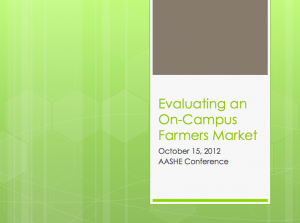
Evaluating an On-Campus Farmers Market at AASHE

This week I was at the Association for the Advancement of Sustainability in Higher Education conference, presenting a session on evaluating on-campus farmers markets. It was based on a survey that I formulated during a Program Evaluation class at Tufts and conducted at Berklee.

.

Some of the results I found from researching other markets’ evaluations that were borne out in my survey:

  • Convenience—location and timing—is the deciding factor in whether someone shops at a farmers market. Most people won’t go out of their way, even if they know about it ahead of time.
  • Clear, prominent signage the day of is more important than advertising beforehand, since most of those who shop at farmers markets don’t plan to; they spontaneously decide to stop after seeing some sort of signage advertising it.
  • Quality of the produce is the most important thing to shoppers, more important than that produce being organic or local, meeting the farmers, or feeling a sense of community.

If you’re interested in more details, check out the slideshow and the full survey.

MA Department of Agricultural Resources and the Boston Local Food Festival

The Massachusetts Department of Agricultural Resources (MDAR) is one of the oldest departments of agriculture in the U.S. Its interests lie in two broad areas: regulatory and promotional. On the one hand it deals with animal health (rabies) and crop and pest services (Asian Longhorn beetle). On the other it deals with agricultural conservation and technical assistance (grants for farm energy enhancement projects) and agricultural markets (farmers markets and CSAs). As such, it’s a great resource for the many farmers who participate in the Boston Local Food Festival, and someone from each division is represented there each year.

.

 To find out more about MDAR, I spoke to Anna Waclawiczek, chief of staff for administration. Read more at the Boston Local Food Festival blog.

Renting Out Our Car with Relay Rides

I’ve already talked about renting cars through Relay Rides. Not that I’ve had to do it often, but it’s a useful option to have, and with no yearly membership fee, it’s a cheap, easy one, too. But for the last two months I’ve been on the other side of that particular transaction. Yup—I’ve been renting out my car through Relay Rides.

Isn't it purty?

It’s been easier than I expected. The five people who have rented the car so far have been clean, considerate, and mostly on time. How does it work?

  • Sign up through Relay Rides. There are some requirements because they want a reliable fleet, so check to see if your car is eligible. Our old one had too many miles.
  • Set the charge. Relay Rides takes 40% of what’s charged to the renter, so factor that into your calculations. (We didn’t at first.) We now have ours set to $9/hour, $70/day. This means that we get $5.40/hour, $42/day. If a person exceeds the mileage limit, this barely exceeds the depreciation ($0.23 per mile for a new car, according to the IRS), so we’re not making that much profit on it in the end. But I think of it as borrowing from my future self, and in the process putting something to use that would otherwise just be taking up a parking space all weekend long.
  • Reserve your own car. You should block out the times that your car definitely won’t be available. For us, that’s usually weekdays, since Jason takes it to work. You can’t set up recurring reservations on their calendar (a huge oversight), so we’ve started just blocking out Sunday night through Friday evening to save time. It means people aren’t able to rent it weekday evenings, but that’s fine with us.
  • Confirm reservations. You’ll get an email (or text) when someone requests your car, and you have to either approve or reject them. Do this quickly, since Relay Rides reports your average response time on your profile. If you need to, you can email people in order to work out the details before approving a reservation.
  • Check odometer and gas. There’s a “limit” of 200 miles a day, but it’s only a limit in that people have to pay a per-mile fee of $0.25 after that. (This happens all the time for the day rentals. Just email Relay Rides with the extra mileage.) I take before and after photos of the dashboard that show the mileage and gas (which they’re supposed to replace).
  • Hand off the keys. Unless you want to have a mobile access device installed (after you have two good reviews, you can buy one for $100), you email the renter to arrange for key pickup. It’s a good opportunity give them more info about the car (like, make sure to step on the brake when you hit the start button) and check their license (Relay Rides confirms that they have a valid license, but you check that it matches the person you’re giving the keys to). I was anxious about this at first, but I think the initial face-to-face interaction makes the whole thing more positive. They’re more likely to treat your car well, and you’re more likely to be flexible if they’re late.
  • Receive the keys. After the rental, arrange for key drop-off, check the car’s condition, and email Relay Rides with extra mileage or gas charges.
  • Get paid. Relay Rides mails you a check each month—through snail mail, so there’s quite the delay between rental and payment. But, hey, we made $179 last month, so it seems worth it.

So far I’ve had only positive experiences with renters, but if something does happen, Relay Rides insures your car for a million dollars. That’s partially what their fee goes to. There has been one instance where someone in a Relay Rides car got into an accident that killed them and seriously injured four people, and the company was quick to reassure people that even if medical bills topped $1 million, the owner would not be liable for them. This has been the only case of its kind, so the principle hasn’t been tested much, but I’m reassured.

The extra cash is nice, but the real reason I love doing this is that it ensures that Jason keeps the car clean, instead of treating it like a trash can. Bonus!

So what do you think? Would you rent out your car? Do you want to rent ours?

Interview with Save That Stuff’s Adam Mitchell

Over on the Boston Local Food Festival blog, I talk to to Save That Stuff’s Adam Mitchell about how the company is able to divert so much waste for the festival. (They’re so successful that we’ve contracted the company for the Berklee BeanTown Jazz Festival in September!) I was also really interested in what he had to say about community outreach and building sustainable businesses—read on for the second part of that interview.

As a Sustainable Business Network board member, how do you participate in their outreach?
This past year I’ve put my efforts into building a Brookline Local First movement. That’s been very satisfying, because it’s helping to build the SBN as a statewide organization by building strong local networks. I really felt that was one of the most important impacts that I could have as a board member—to work in my local community. We had a conference call last week talking about how to keep your members engaged, how to plan events regularly so that they know when they happen, and how to recruit more people to join.

Adam Mitchell

Any advice for motivating people to participate?
Once you have a winning recipe, you’ve got to freshen it up so people stay interested and engaged. I’m a big fan of the pledge. McKenzie [author of Fostering Sustainable Behavior] says it takes people about 20 times to hear anything and comprehend it. Whereas if you make them act, for instance signing their name to a pledge poster, the physical prompt of actually putting pen to paper embeds that mission in their brain a lot more. And that’s the neat thing about the food festival; it’s getting people to actively sort, so it’s going to embed that message in their brain in the same way.

The City of Cambridge was looking into how they could increase participation in one of their lower-diversion neighborhoods, so they engaged the local Little League team in a project. For a couple weeks they did a set-out report, how many apartment buildings or units were setting out their recycling carts each week. They targeted the ones that weren’t setting them out, and they sent the baseball team there to say, “If we can increase participation here in the recycling program by x%, the city of Cambridge is going to donate $500 to our Little League team. Would you help us?” They actually got a fair number of people to start supporting them through recycling. So it’s looking for that other hook, as opposed to just being good for the environment.

How does Save That Stuff fit with the Sustainable Business Network?
A lot of ways our mission is the same as the SBN’s: building economies that are green, local, and fair. The green we’ve got covered. We’re also the largest locally owned recycler in Boston. And we’ve had a long history of, for instance, helping our helpers on the trucks to become drivers, and helping our sorters in the plant to move up and become supervisors—just looking for an opportunity for folks to grow with the organization and compensate them fairly.

How did the event recycling side of your business start?
Eight years ago, my wife and I would set up the recycling racks at the Falmouth Road Race and work with the volunteers. My kids would come along and I’d pay my son $20 to help with the box truck, to pick up the recycling and the racks. And just like any small business, it grows to a point where you can formalize it and have staff, which is very satisfying.

I just saw it as another service that we could offer. It was a way of getting our name out there and also helping to fill a hole, because no one else was doing it.

Saturday Green Links – 8/15

People talk about the ethical reasons not to wear leather, but not often the environmental ones. Jason worked in a tannery once—after stricter environmental regulations were implemented—and believe me, it was still disgusting.

That’s all for now. If you come across anything interesting this week, send it my way.